Your Rights Against Solar Companies: Protection Guide
Your legal rights against solar companies explained. Learn about state consumer protection acts, cooling-off periods, contract cancellation, and consumer remedies.
Your rights against a solar company usually come from timing, paperwork, and proof. The strongest routes often involve the FTC Cooling-Off Rule, Truth in Lending Act disclosures, state UDAP/DTPA statutes, contractor licensing rules, warranty law, lien rules, or lender defenses when the installer used a financed consumer contract.
Disclaimer: This article is general legal information, not legal advice. Solar fraud rights depend on your state, contract, evidence, and deadlines.
Homeowners have significant legal rights when dealing with solar companies, including contract cancellation rights, consumer protection laws, and remedies for fraud. Understanding these rights can help you avoid scams, cancel bad contracts, and recover losses if you've been victimized.
This guide explains your legal rights against solar companies under federal and state laws, how to exercise those rights, and what remedies are available when solar companies violate consumer protection laws.
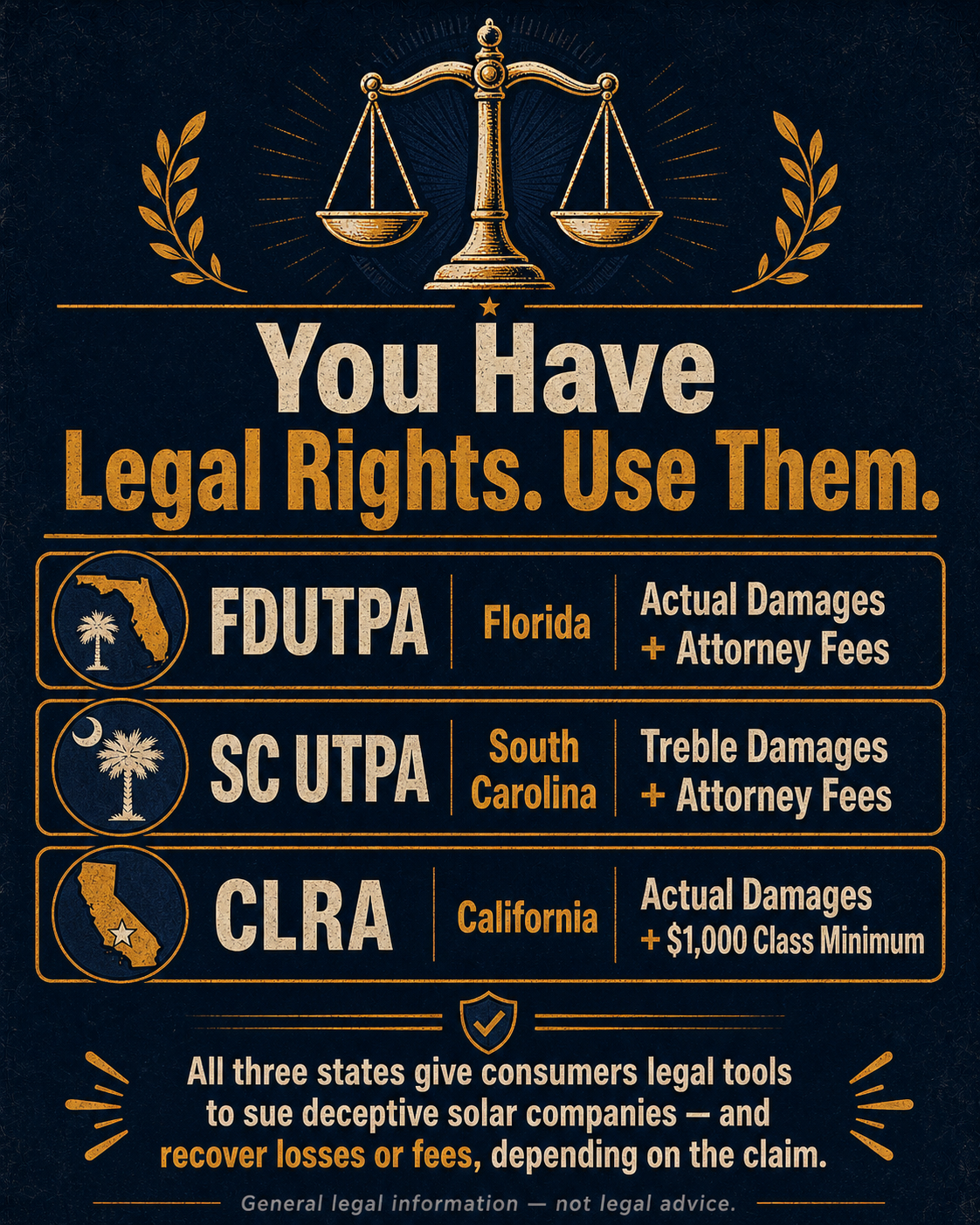
If your solar dispute involves Florida, South Carolina, or California, start by identifying which consumer protection law may apply. FDUTPA, SC UTPA, and the CLRA/UCL framework all target deceptive business practices, but the available damages, attorney-fee rules, notice requirements, and litigation strategy differ. Use this page as the national overview, then move into the state-specific guide that matches your property.
Federal Consumer Protection Rights
Three-Day Cooling-Off Rule (Door-to-Door Sales)
The FTC's Cooling-Off Rule gives you the right to cancel most solar contracts signed in your home within three business days:
When it applies:
- Contract signed at your home (door-to-door sales)
- Contract signed at seller's temporary location (trade show, fair)
- Sale over $25
- Solar leases, PPAs, and purchase contracts
How to exercise:
- Written cancellation notice (not just phone call)
- Delivered by midnight of the third business day
- Send by certified mail (for proof)
- Email backup to company representative
What happens:
- Company must refund all payments within 10 days
- Must return any trade-in items
- Must cancel any financing
- Cannot charge cancellation fees
Important: Many solar salespeople won't tell you about this right. Exercise it immediately if you have regrets.
Truth in Lending Act (TILA)
TILA requires clear disclosure of solar financing terms:
Lenders must disclose:
- Annual Percentage Rate (APR) – true cost including fees
- Finance charges – total interest and fees
- Amount financed – principal after down payment
- Total of payments – you'll pay over loan term
- Payment schedule – amount and number of payments
- Prepayment penalties – if any
Your TILA rights:
- Right of rescission: 3 days to cancel home-secured loans
- Accurate disclosures: Errors may give you rescission rights
- Advertising accuracy: teaser rates must be available
TILA violations are serious and may allow you to rescind the loan and recover damages.
Fair Credit Reporting Act (FCRA)
FCRA protects you when solar companies check your credit:
Requirements:
- Written permission required for credit checks
- Adverse action notice if denied financing
- Credit score disclosure if used in decision
- Identity verification requirements
Your FCRA rights:
- Know what's in your credit file
- Dispute inaccurate information
- Free annual credit report
- Seek damages for violations
Telephone Consumer Protection Act (TCPA)
TCPA restricts how solar companies can call you:
Prohibited practices:
- Robocalls to cell phones without consent
- Calls before 8 AM or after 9 PM
- Calls to numbers on Do Not Call Registry
- Failing to honor opt-out requests
TCPA penalties:
- $500-$1,500 per illegal call
- Class action lawsuit potential
- State attorney general enforcement
Document illegal calls – log date, time, number, and message content for potential claims.
Electronic Fund Transfer Act (EFTA)
EFTA protects automatic payments for solar loans:
Your rights:
- Stop payment on pre-authorized transfers
- Error resolution procedures
- Limited liability for unauthorized transfers
- Written receipts for electronic transfers
State Consumer Protection Laws
State Consumer Protection Acts (DTPA/UDAP)
Most states have consumer protection laws prohibiting unfair and deceptive practices:
Common prohibited practices:
- False or misleading representations – Lies about savings, incentives, or terms
- Failure to disclose material facts – Hiding important information
- Unconscionable practices – Grossly unfair terms or conduct
- Breach of warranty – Failing to honor guarantees
DTPA/UDAP remedies typically include:
- Actual damages (money lost)
- Attorney fees (often recoverable)
- Court costs
- In some states: treble damages (3x actual damages)
- In some states: minimum statutory damages ($500-$5,000)
Time limits:
- Usually 2-4 years from violation
- May extend if fraud concealed
- Varies by state
State Contractor Protection Laws
Licensed solar contractors must comply with:
Licensing requirements:
- Valid contractor license for your state
- Proper classification (electrical, solar, general)
- Insurance and bonding requirements
- Continuing education requirements
Your rights:
- Verify license status online
- File complaints with licensing board
- Recover from contractor bond
- Report unlicensed activity
Many states offer additional protections:
- Recovery funds for victims of licensed contractors
- Expedited complaint handling
- Automatic license suspension for fraud
State-Specific Enhanced Protections
Some states have stronger consumer protections:
California:
- Solar Consumer Protection Guide required
- Strong DTPA with 3x damages for willful violations
- Enhanced elderly protections (over 65)
South Carolina:
- Unfair Trade Practices Act with treble damages for willful violations
- Enhanced protections for elderly consumers (65+)
- Home solicitation sales protections
Florida:
- Strong consumer protection statutes
- Hurricane and storm-related solar protections
- Cooling-off period for home solicitation sales
New York:
- General Business Law Article 22-A
- $500 minimum statutory damages
- Enhanced protections for seniors
Contract Rights and Remedies
Breach of Contract Claims
When solar companies breach agreements:
Material breaches:
- Failure to install system
- Installation of different equipment
- Abandoning project after payment
- Failing to meet performance guarantees
- Refusing to honor warranty
Your remedies:
- Damages: Cost to repair or complete
- Rescission: Cancel contract, get refund
- Specific performance: Force completion
- Consequential damages: Secondary losses
Contract Rescission Rights
Grounds for rescinding solar contracts:
Fraudulent inducement:
- Misrepresentation of material facts
- False promises about savings
- Hidden terms or costs
- Misrepresentation of government programs
Mutual mistake:
- Both parties mistaken about material fact
- Unworkable site conditions
- Misunderstanding of scope
Unconscionability:
- Grossly unfair terms
- No meaningful choice
- Oppressive provisions
Rescission effect:
- Both parties restored to pre-contract position
- Refund of payments
- Return of any benefits received
- As if contract never existed
Warranty Rights
Solar companies must honor warranties:
Types of warranties:
- Manufacturer warranties – Equipment defects
- Workmanship warranties – Installation quality
- Performance warranties – Energy production
- Roof penetration warranties – Leak protection
Warranty claim process:
- Notify company of defect
- Provide documentation
- Allow reasonable inspection
- Demand repair or replacement
If warranty denied:
- Document the denial
- Get second opinion
- File consumer protection complaint
- Consider legal action
Property and Lien Rights
UCC-1 Financing Statement Rights
Understanding solar financing liens:
What UCC-1 filings mean:
- Lender has security interest in solar equipment
- Filed with Secretary of State
- Not a mortgage on your home
- Can complicate refinancing or sale
Your rights:
- Must be authorized in contract
- Must be filed properly
- Must be released upon payoff
- Can be disputed if improper
Mechanic's Lien Rights
Contractors may file liens for unpaid work:
Requirements for valid lien:
- Work actually performed
- Proper notice given
- Filed within statutory deadline
- Amount claimed is accurate
Challenging invalid liens:
- Bond around the lien
- File lien foreclosure lawsuit
- Negotiate release
- Seek damages for wrongful lien
Property Transfer Rights
Your rights when selling home with solar:
Lease/PPA transfers:
- Buyer's credit approval often required
- Transfer fees may apply
- Remaining payments buyer's responsibility
- Some buyers refuse to assume
Loan payoff:
- UCC-1 lien must be released
- Lender must provide payoff statement
- Escrow can handle payment
- Verify release filed
Remedies and Damages
Types of Available Damages
Actual damages (compensatory):
- Money paid to solar company
- Repair costs
- Lost energy savings
- Property damage
- Attorney fees (sometimes)
Consequential damages:
- Damage to roof or home
- Increased utility costs
- Relocation costs during repairs
- Mental anguish (limited in contract cases)
Punitive damages:
- For willful misconduct
- Gross negligence
- Fraudulent intent
- Statutory caps may apply
Statutory damages:
- Set amounts in consumer protection laws
- Often $500-$5,000
- May not require proving actual damages
- Attorney fees may be added
Attorney Fee Provisions
Many consumer laws allow fee recovery:
When attorney fees are recoverable:
- State consumer protection act violations (many states)
- Promissory note terms
- Contractual provisions
- Successful defense of frivolous claims
Why this matters:
- Attorneys take cases they might otherwise decline
- Shifts cost of enforcement to violators
- Encourages compliance
Enforcement and Complaint Procedures
Administrative Complaints
File complaints with:
State Attorney General:
- Consumer protection division
- Pattern of practice investigations
- Restitution programs
State Licensing Boards:
- Contractor violations
- License suspension/revocation
- Recovery fund claims
Better Business Bureau:
- Mediation services
- Public complaint record
- Company rating impact
Federal Trade Commission:
- reportfraud.ftc.gov
- Pattern analysis
- Potential enforcement
Small Claims Court
For smaller disputes ($3,000-$10,000 typical limits):
Advantages:
- No attorney required
- Faster than regular court
- Lower costs
- Informal procedures
Process:
- File complaint with court clerk
- Pay filing fee ($50-$300)
- Serve defendant
- Present evidence at hearing
- Obtain judgment
- Collect (garnishment, liens)
Civil Litigation
For larger disputes or complex cases:
When to litigate:
- Losses exceed $10,000
- Complex legal issues
- Precedent-setting importance
- Defendant has assets
Process:
- Hire attorney (often contingency)
- File complaint
- Discovery (evidence exchange)
- Settlement negotiations
- Trial (if no settlement)
- Appeal (if necessary)
Timeline:
- Settlement: 3-12 months
- Trial: 1-3 years
- Appeal: +1-2 years
Protecting and Exercising Your Rights
Documentation Best Practices
Preserve all evidence:
- Keep all contracts and amendments
- Save all emails and texts
- Record phone calls (if legal in your state)
- Take photos of installation/problems
- Log all interactions
- Save marketing materials
Timeline Considerations
Act promptly:
- Cooling-off periods: 3 days
- TILA rescission: 3 days
- Credit card disputes: 60 days
- Contract claims: 4-6 years typically
- State consumer protection claims: 2-4 years typically
Don't delay – waiting can forfeit rights.
Getting Legal Help
When to consult an attorney:
- Losses exceed $5,000
- Complex contract issues
- Multiple violations
- Company unresponsive
- Criminal conduct suspected
Types of attorneys:
- Consumer protection attorneys
- Contract litigation attorneys
- Construction defect attorneys
- Class action attorneys
Official Legal Sources
Use primary sources to verify the legal hook before relying on a salesperson, servicer, or complaint script:
- The FTC Cooling-Off Rule is codified at 16 CFR Part 429 and covers many sales made at a home or temporary business location: FTC Cooling-Off Rule text.
- The Truth in Lending Act rescission statute is at 15 USC § 1635: TILA rescission statute.
- The FTC Holder Rule is codified at 16 CFR Part 433 and can preserve claims and defenses against certain consumer-credit contract holders: FTC Holder Rule text.
- The CFPB explains how consumers can submit complaints involving loans, credit reporting, debt collection, and other financial products: CFPB complaint portal.
- The FCC explains robocall and telemarketing restrictions relevant to unwanted solar sales calls: FCC telemarketing and robocalls guide.
State-Specific Rights Guides
For detailed information on your state's specific laws:
- Solar Panel Scams in Florida: Legal Rights
- Solar Panel Scams in California: Legal Rights
- Solar Panel Scams in Arizona: Legal Rights
- Solar Attorney California: Legal Help
- Solar Attorney Florida: Legal Resources
Related Resources
- Solar Fraud Attorney: How to Sue a Solar Company
- Solar Contract Lawyer: Pre-Signing Review
- How to Report Solar Panel Fraud
- How to Avoid Solar Panel Scams
- Solar Company Lawsuits: Major Cases
FAQ
What legal rights do homeowners have against solar companies?
Homeowners may have rights under the FTC Cooling-Off Rule, Truth in Lending Act, Fair Credit Reporting Act, state UDAP or DTPA laws, contractor licensing laws, warranty law, and the contract itself. The strongest path depends on timing, state law, contract language, and evidence.
Can I cancel a solar contract after three days?
Sometimes. The three-day window is important, but fraud, missing cancellation notices, TILA disclosure defects, elder-protection statutes, contractor violations, or state consumer-protection laws may create additional arguments. Do not assume the case is dead just because three days passed.
What evidence should I gather before calling a lawyer?
Gather the signed contract, financing agreement, proposal, sales texts, utility bills, production data, payment history, photos, inspection reports, UCC filings, and complaint correspondence. The solar scam evidence checklist is built for this exact first pass.
How do I know which law applies to my solar problem?
Start by naming the pattern: door-to-door pressure, fake savings, hidden dealer fee, unauthorized credit pull, forged e-signature, lien problem, underproduction, or installer abandonment. The solar scam pattern database maps those patterns to likely evidence and next-step guides.
Should I file a complaint or sue first?
Most homeowners should preserve evidence first, then consider a regulator complaint, written demand, lender dispute, small claims case, arbitration, or attorney review. Filing a rushed complaint with weak documents can make the story look thinner than it really is.
Next Steps
Believe your rights have been violated? Our consumer research team can help you understand your options and point you toward appropriate resources. We don't provide legal advice, but we can share research and information.
This article is for informational purposes only and does not constitute legal advice. Laws vary by state and situation. Consult with a qualified attorney for advice about your specific circumstances.
Next Research Steps
Use these resources to connect this issue with the broader solar scam pattern, the relevant legal framework, and the next practical action.
Solar panel scams
Start with the main solar panel scams guide for the broad definition and recovery roadmap.
Homeowner legal rights
Review cancellation, rescission, UDAP, TILA, Holder Rule, arbitration, and lawsuit options.
Solar fraud by state
Compare state and city issues against the national solar fraud map.