Solar Loan Dealer Fees Explained: The Hidden Cost of Low APR
Comprehensive guide to solar dealer fees. Learn how these upfront add-ons offset advertised rates, calculate true costs, and protect yourself from hidden financing charges.
A solar dealer fee is an upfront financing cost that can inflate the system price or loan principal in exchange for a lower advertised APR. The only reliable way to spot it is to compare the cash price, financed amount, finance charge, total of payments, and any written dealer-fee disclosure.
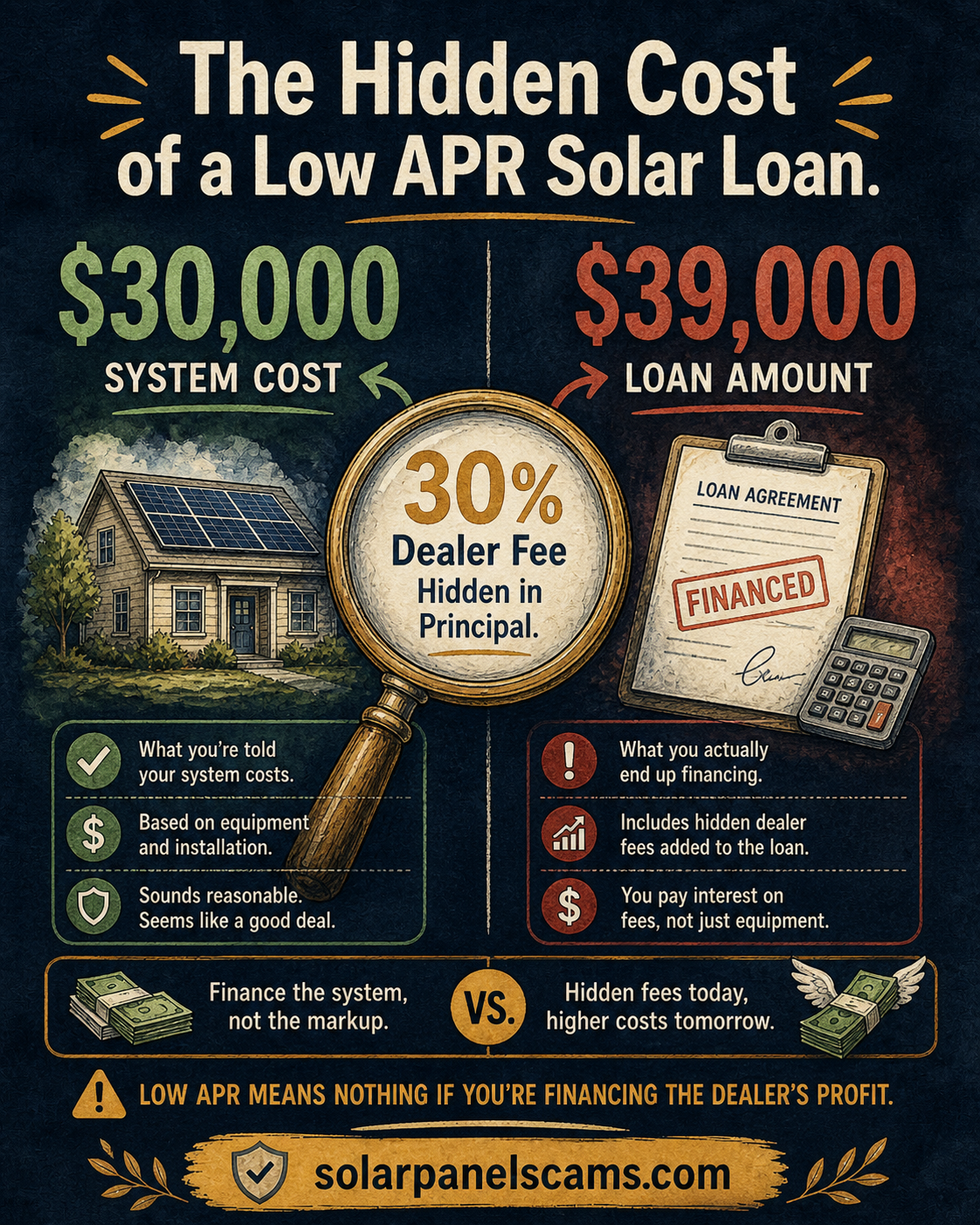
Some solar lenders offer products in which an installer pays an upfront fee or rate-buydown cost connected to a lower advertised rate. How that cost appears in the transaction varies. A higher financed price is not by itself proof of a hidden fee or fraud, so compare same-scope documents before assigning a label.
The graphic uses hypothetical numbers to illustrate the question every homeowner should ask: why is the financed price higher than the cash price? The difference could include a rate buydown, financing cost, battery, roof work, electrical upgrade, tax, or another add-on. Reconcile each item before deciding what the gap represents.
This page explains financing mechanics. Homeowners auditing an agreement they already signed should use the broader post-sign solar pricing worksheet to separate the array, add-ons, financing, and evidence.
What Are Solar Dealer Fees?
The Basic Concept
A "dealer fee" is a term used for some lender-to-installer charges associated with a financing product. Related documents may use different labels, and not every solar loan has the same structure. The CFPB's 2024 solar-financing spotlight reported that, in the evidence it reviewed, hidden fees often ranged from 10% to 30% of cash price and could exceed 50%. That is an attributed finding, not a national rate for every loan.
| Question | Record to compare | What it can establish |
|---|---|---|
| Is there a same-scope cash/financed gap? | Written cash and financed proposals from the same seller | The size of the gap, not its composition |
| Is a fee or buydown disclosed? | Contract, itemization, state disclosure, and lender records | The label, amount, recipient, and financing treatment stated in the documents |
| What does the credit cost? | Regulation Z disclosures and payment schedule | APR, finance charge, amount financed, and total of payments as federally defined |
Misleading presentation becomes a concern when material cost or financing information conflicts with or is omitted from what the consumer was told. A low APR alone does not establish deception.
How the Math Works
Example: The True Cost of a "Low" APR:
| Component | Amount |
|---|---|
| System cash price | $30,000 |
| Dealer fee (30%) | $9,000 |
| Total financed | $39,000 |
| Advertised APR | 1.99% |
| Loan term | 25 years |
| Monthly payment | ~$165 |
| Total paid over 25 years | $49,500 |
| Cost vs. cash price | $19,500 more |
Alternative: Credit Union Loan:
| Component | Amount |
|---|---|
| System cash price | $30,000 |
| Dealer fee | $0 |
| Total financed | $30,000 |
| APR | 6.99% |
| Loan term | 20 years |
| Monthly payment | ~$232 |
| Total paid over 20 years | $55,680 |
| But paid off 5 years earlier | Save $8,200 in last 5 years |
Illustration only: These invented amounts compare different terms and rates. They are not market quotes and do not prove which product is better for a particular borrower. Replace every input with current written offers and compare total cash flows over matching horizons.
The Mechanics of Dealer Fees
How Lenders and Solar Companies Structure These Deals
Step-by-Step Process:
Hypothetical lender rate sheet
- Base rate (no fee): 8.99% APR
- Rate with 20% fee: 5.99% APR
- Rate with 30% fee: 1.99% APR
- Rate with 35% fee: 0.99% APR
Seller selects an available product
- A lower rate may be paired with a higher upfront cost.
- Compensation and product menus vary by seller and lender.
- The consumer needs the price and total credit cost, not the rate alone.
The transaction is priced and financed
- The financed price may include solar equipment and other items.
- Borrowers repay principal plus credit costs under the note.
- The documents must show how the stated figures reconcile.
Payment Structure
- Lower monthly payment (stretched over longer term)
- Much higher total cost
- Harder to refinance due to negative equity
Why Solar Companies Love Dealer Fees
| Benefit to Solar Company | Impact on Consumer |
|---|---|
| Higher system prices | Less price sensitivity due to focus on monthly payment |
| Faster sales | Low APR makes decision easier |
| Competitive advantage | Can advertise "1.99% financing!" |
| Compensation incentives | Ask who is paid by whom and whether compensation changes by product |
| Less comparison shopping | Monthly payment focus obscures total cost |
Compensation may create incentives, but the structure must be verified rather than assumed. Ask for seller, installer, lender, and broker identities and preserve any compensation disclosure.
The True Cost Calculator
Comprehensive Cost Comparison
Scenario: $30,000 System, Various Financing Options
| Financing Method | Total Cost | Monthly Payment | Term | Cost vs. Cash |
|---|---|---|---|---|
| Cash purchase | $30,000 | N/A | N/A | $0 (baseline) |
| Dealer fee loan (30%, 1.99%) | $49,500 | $165 | 25 yrs | +$19,500 |
| Dealer fee loan (20%, 3.99%) | $45,600 | $190 | 25 yrs | +$15,600 |
| Credit union (0% fee, 6.99%) | $55,680 | $232 | 20 yrs | +$25,680 |
| HELOC (0% fee, 7.50%) | $57,000 | $237 | 20 yrs | +$27,000 |
| Home equity loan (0% fee, 7.00%) | $55,860 | $433 | 10 yrs | +$25,860 |
Key point: The table is hypothetical. Compare current written offers using the same system scope, term horizon, prepayment assumption, and total cash paid.
Hidden Cost Multipliers
How Fees Compound Over Time:
Do not estimate this from a national percentage. Measure the same-scope cash-to-financed gap, then use the actual payment schedule and payoff terms. The amount financed, finance charge, and total of payments are distinct Regulation Z concepts; none alone identifies a dealer fee.
Red Flags: Spotting Dealer Fee Deception
During the Sales Process
Questions to resolve:
| Statement | What It Means | Your Response |
|---|---|---|
| "Low APR" | May involve a rate buydown or different pricing | "What are the same-scope cash price, financed price, and total of payments?" |
| "No money down" | Describes upfront payment, not total cost | "What is the amount financed and full payment schedule?" |
| "Special financing today only" | May be a real or sales-created deadline | "Who sets the deadline, and where is it written?" |
| "This will not affect credit much" | Requires lender and reporting details | "What inquiry, account, balance, and reporting should I expect?" |
| "Everyone qualifies" | Requires actual underwriting terms | "What are the approval criteria and final conditions?" |
Dealer fees are one item on a longer list of financing warning signs. For the full pre-signature sweep, see how to spot predatory solar financing.
In Loan Documents
🚩 Document Red Flags:
| Issue | What to Look For | Why It Matters |
|---|---|---|
| Financed price > cash price | Same-scope written proposals | A gap that needs itemization |
| Different rate labels | Note, contract, and federal disclosures | Whether the figures have different legal definitions or conflict |
| Vague charge descriptions | Itemization and recipient | What the charge covers and who receives it |
| Missing expected disclosures | Complete closing package | A reason to pause and obtain qualified review |
| Prepayment terms | Note and payoff provision | Whether and how early payoff changes cost |
Questions That Reveal the Truth
The Essential Four:
"What is the exact cash price for this system?"
- Get it in writing
- Compare same-scope local proposals
"What is the total amount I will be financing?"
- If higher than cash price, ask why
- Get fee percentage
"What is the dealer fee percentage and dollar amount?"
- If they say "no dealer fee," verify financed amount equals cash price
- A higher financed price requires itemization; it does not identify the cause by itself
"What would my total cost be with a credit union loan at their current rate?"
- Forces comparison
- Reveals true cost difference
Legal Protections and Violations
Truth in Lending Act (TILA) Requirements
What Lenders Must Disclose:
| Required Disclosure | Purpose | Common Violations |
|---|---|---|
| Annual Percentage Rate (APR) | True cost including fees | Misleadingly low APR hiding fees |
| Finance charge | Dollar cost of consumer credit under Regulation Z | Check the calculation and included charges |
| Amount financed | Credit amount determined under Regulation Z | Reconcile it with the itemization and contract |
| Total of payments | Sum of all payments | Not accounting for fee impact |
| Payment schedule | Amount and timing of payments | Hiding escalators or balloons |
Your Rights Under TILA:
Coverage, rescission, damages, limitations periods, and fee rules depend on the credit transaction and law. Do not assume a solar installment loan has the same rescission right as a covered home-equity transaction. A consumer lawyer can assess actual disclosure errors and available remedies.
State Consumer Protection Laws
Deceptive Trade Practices:
| Violation | Remedy | Timeline |
|---|---|---|
| Undisclosed or misrepresented cost | Depends on statute, contract, causation, and proof | Varies by state and claim |
| Conflicting loan terms | Correction, damages, or other relief may be available | Depends on governing law and deadline |
| Bait-and-switch allegation | Preserve both offers and the final documents | State-specific review required |
Better Alternatives to Dealer Fee Loans
Option 1: Credit Union Solar Loans
Request a current written quote and compare its origination charges, collateral, term, payment schedule, and total cost. Credit-union status does not guarantee a fee-free or lower-cost product.
Option 2: Home Equity Loans/HELOCs
Home-equity products may have different rates, fees, tax treatment, collateral, and foreclosure risk. Obtain lender disclosures and individual legal and tax advice. Do not assume the interest is deductible or that the product has no origination cost.
Option 3: Cash Purchase
Cash avoids loan interest but is not automatically the best use of funds. Compare the gross cash price, liquidity needs, ownership terms, and independently verified incentives. Section 25D is unavailable for expenditures treated as made after December 31, 2025.
Option 4: Solar-Specific Lenders (Fee-Free)
Ask every lender for a current product with no rate-buydown or seller-paid financing cost, if available, and compare it with other products. Verify the fee structure from documents rather than the lender category.
How to Protect Yourself
The Comparison Shopping Rule
Always Compare These Options:
| Source | What to Get | Key Metric |
|---|---|---|
| Solar installer financing | Full loan disclosure | Total cost including fees |
| Your credit union | Solar loan quote | APR and total payments |
| Your bank | Personal loan quote | APR and origination fees |
| Online lenders | Rate comparison | Total cost of borrowing |
Take Enough Time To Compare
Do not sign under an artificial deadline. Obtain the complete proposal and disclosures, compare costs, and verify any real expiration date from the party that sets it. A fixed universal review period does not replace a contract-specific cancellation deadline.
Documentation Checklist
Before Signing:
- Cash price in writing from 3+ installers
- Total financed amount clearly stated
- Dealer fee percentage explicitly disclosed
- TILA disclosure provided
- Comparison with alternative financing
- Prepayment terms verified
- Credit reporting treatment confirmed
- All promises in writing
If You've Been Victimized
Immediate Steps
If You Just Signed (Cooling-Off Period):
- Read and follow every applicable cancellation instruction immediately.
- Preserve proof of timely delivery using an allowed method.
- Document the sales, contract, loan, and payment records.
- Get state-specific advice; cancellation rights and deadlines vary.
Canceling does not always erase the fee. If the payoff quote still reflects it, see solar dealer fee refunds after cancellation for the itemization and payoff records to request.
If You've Been Paying:
- Reconcile the cash price, financed price, add-ons, finance charge, and payments.
- Gather all loan documents
- Document any misleading statements
- Consult consumer protection attorney
Legal Options
Potential Claims:
| Violation | Remedy | Evidence Needed |
|---|---|---|
| Possible federal disclosure issue | Transaction-specific review required | Actual disclosures and calculation evidence |
| Possible deceptive practice | State-specific remedies and proof | Sales statements, omissions, reliance, and loss |
| Possible contract breach | Contract-specific remedies | Written duties, performance, notice, and damages evidence |
| Possible unfair-term defense | Highly fact- and law-specific | Complete contract and circumstances of formation |
Where to Complain:
- State Attorney General (consumer protection)
- CFPB (lending violations)
- State contractor board (installers)
- Better Business Bureau
Key Takeaways
- A low APR does not show the system's cash price or the loan's total cost.
- Compare same-scope cash and financed proposals before naming the gap.
- Reconcile Regulation Z disclosures with the contract and itemization.
- Use current written offers rather than national fee or rate assumptions.
- Preserve sales representations and every version of the documents.
- Get transaction- and state-specific advice before asserting a legal remedy.
Bottom Line: A dealer fee or rate buydown is not automatically illegal or deceptive. The practical safeguard is to compare identical project scope, require written itemization, and understand the full payment schedule before signing.
Official Sources on Solar Financing Disclosures
- The CFPB's solar financing issue spotlight describes solar loan dealer fees, payment shocks, and risks in third-party solar financing: CFPB solar financing issue spotlight.
- The Truth in Lending Act requires key credit disclosures, including finance charge, APR, amount financed, total of payments, and payment schedule: TILA disclosures statute.
- The Department of Energy explains the difference between solar loans, leases, PPAs, and cash purchases: DOE homeowner's guide to solar financing.
- The FTC warns that solar sellers should not misrepresent financing terms, costs, savings, rebates, or tax credits: FTC business guidance on solar scams.
- The CFPB complaint portal is the federal intake path for lending, servicing, debt collection, and credit reporting issues: CFPB complaint portal.
FAQ
What is a solar dealer fee?
A solar dealer fee is a term used for some lender-to-installer charges associated with a financing product or rate buydown. How the transaction passes through or discloses that cost varies, so verify the actual documents.
Are solar dealer fees illegal?
Not automatically. The problem is nondisclosure or misleading presentation. If the salesperson sells the loan as a bargain rate without explaining the inflated principal, the pitch can cross into deceptive financing.
How do I spot a hidden dealer fee?
Ask for the same-scope cash and financed prices, amount financed, finance charge, total of payments, and itemization. A gap is evidence to investigate, not proof of a particular fee.
Is a higher APR loan sometimes cheaper than a low APR solar loan?
Yes. A product with a higher rate can cost less overall if its upfront costs, principal, or term are lower. Use current written offers and compare total cash flows, not lender labels or monthly payment alone.
What should I do if the dealer fee was hidden from me?
Save the contract, TILA disclosures, proposal, texts, and screenshots, then compare the loan against the dealer fee breakdown guide and solar financing scams guide. If the numbers do not reconcile, consider a consumer-protection attorney.
Related Reading
- Solar Financing Scams: Complete Guide
- Truth in Lending Act Rights
- Credit Union vs. Solar Financing Comparison
Last updated: 2026-08-18. Calculate total costs carefully before committing to any solar financing.
Got blindsided by a solar deal that did not deliver?
Your documents may support a contract, disclosure, financing, or consumer-protection issue. Claims, remedies, deadlines, and fee rules depend on the transaction and state. Our eligibility form organizes the facts for review and may route qualifying matters toward a consumer-protection attorney.
Next Research Steps
Use these resources to connect this issue with the broader solar scam pattern, the relevant legal framework, and the next practical action.
Solar panel scams
Start with the main solar panel scams guide for the broad definition and recovery roadmap.
Solar financing fraud compensation
Use this guide for loan, dealer-fee, payment-jump, PACE, lease, and lender-defense issues.
Homeowner legal rights
Review cancellation, rescission, UDAP, TILA, Holder Rule, arbitration, and lawsuit options.