"Free Solar Panels" Scams: The Hidden Cost Trap Exposed
Why free solar panel offers are rarely free. Learn about TPO agreements, lease escalators, hidden fees, and why zero-down solar often costs more than buying.
"Free solar panels" are usually not free. In most door-to-door, social media, or phone pitches, "free" means a lease, power purchase agreement, or no-money-down loan where the homeowner still pays through monthly payments, escalators, transfer obligations, or inflated financing.
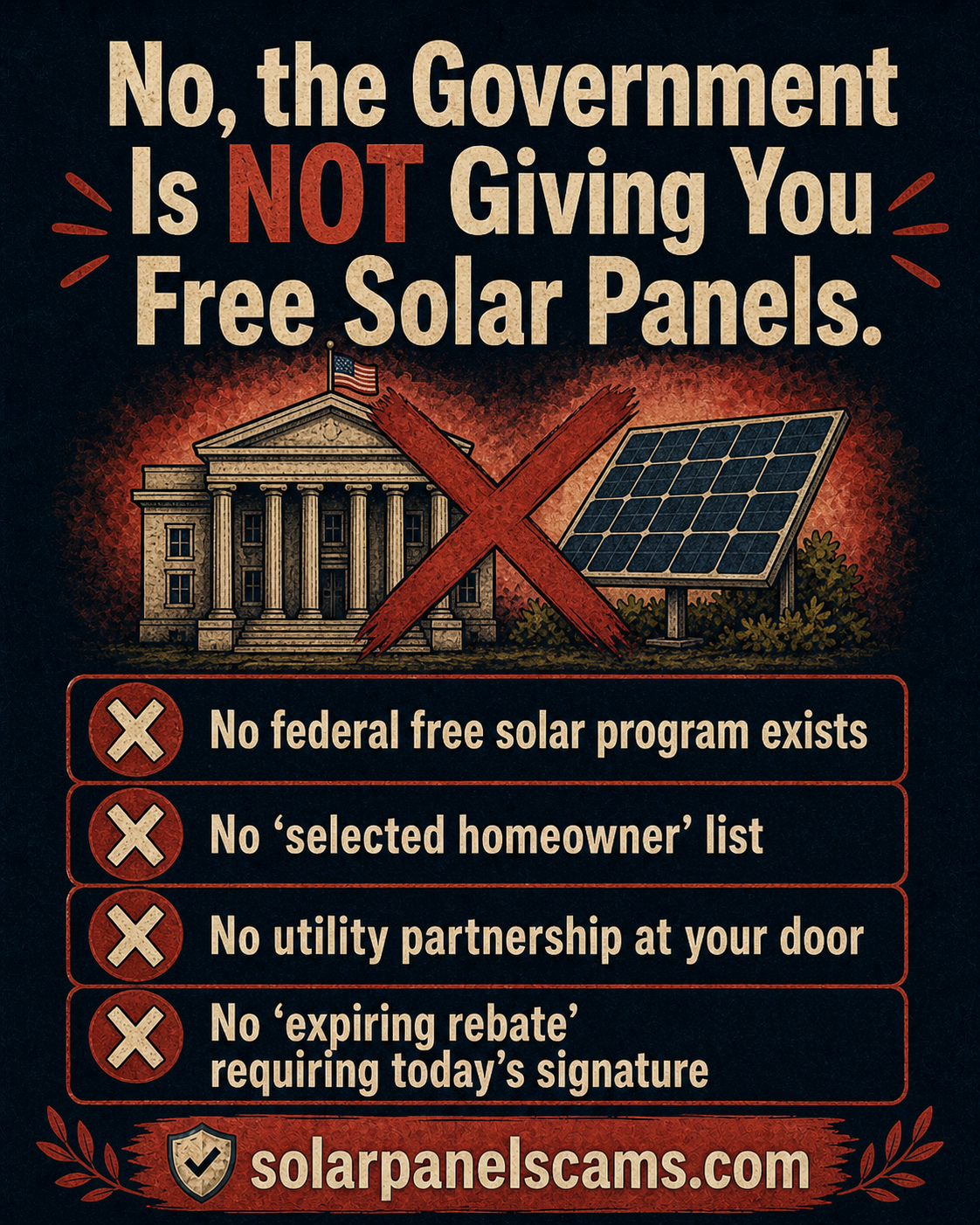
You've seen the ads: "Get FREE Solar Panels!" "No Cost Solar Program!" "$0 Down Solar Installation!" These offers flood social media, radio, and door-to-door sales pitches. But here's the truth: there's no such thing as free solar panels. What these marketers are selling isn't free—it's a financial product that often costs more over time than buying a system outright.
This guide exposes how "free solar" scams work, what you're really signing up for, and why these offers are rarely the deal they appear to be.
The graphic above captures the core rule: a real public incentive does not require a same-day door-step signature. If the pitch mentions a "selected homeowner" list, a secret utility partnership, an expiring government rebate, or free panels paid for by Washington, verify it through official sources before sharing an electric bill, Social Security number, or signature.
Understanding "Free Solar" Offers
What They Really Mean
When you see "free solar panels," the company is offering one of these third-party ownership (TPO) models. To sort a real incentive from a repackaged sales pitch, run the offer through the five-part test for free energy programs:
| Offer Type | What It Actually Means |
|---|---|
| "Free solar panels" | Solar lease—you don't own the system |
| "$0 down solar" | No upfront cost, but monthly payments for 20-25 years |
| "No cost solar program" | PPA where you pay per kWh, not a fixed price |
| "Government-funded solar" | No such program exists |
| "Utility-sponsored free solar" | Utilities don't give away solar panels |
The TPO Model Explained
Third-Party Ownership means someone else owns the solar panels on your roof:
Solar Lease:
- You pay a fixed monthly amount to "rent" the panels
- Lease company owns the system; any owner-side tax treatment depends on the applicable law and placed-in-service date
- Typically 20-25 year contracts
- Payments escalate annually (usually 2.9%)
Power Purchase Agreement (PPA):
- You pay per kWh the system produces
- Rate typically starts below utility rates
- Rate escalates over time (usually 2.9% annually)
- 20-25 year contracts
Why "Free Solar" Costs More Than Buying
The Math: Lease vs. Purchase
Illustrative scenario, not a market benchmark:
- System size: 8 kW
- Same-scope cash proposal: $24,000 before incentives
- Lease proposal: $0 down with a starting $150 monthly payment and a stated annual escalator
Lease Option:
- $0 down
- Monthly payment: $150 (year 1)
- Annual escalation: 2.9%
- 25-year lease term
Total Lease Cost Over 25 Years:
- Year 1-5 average: $150/month = $9,000
- Year 6-10 average: $172/month = $10,320
- Year 11-15 average: $198/month = $11,880
- Year 16-20 average: $227/month = $13,620
- Year 21-25 average: $261/month = $15,660
Total: $60,480
This hypothetical lease totals $60,480 under the stated assumptions. It does not prove that the system is worth $24,000 or that every lease is overpriced; compare local same-scope proposals, production assumptions, maintenance obligations, and transfer terms.
The Escalator Trap
How Annual Increases Destroy Savings:
| Year | Monthly Payment | Annual Cost |
|---|---|---|
| 1 | $150 | $1,800 |
| 5 | $168 | $2,016 |
| 10 | $193 | $2,316 |
| 15 | $222 | $2,664 |
| 20 | $255 | $3,060 |
| 25 | $293 | $3,516 |
By year 20, you're paying 70% more than when you started.
When Leases Cost More Than Utilities
The Savings Disappears When:
- Utility rates don't increase as projected (leases assume 3-5% utility increases)
- Your system underperforms (shade, soiling, degradation)
- You sell your home (transfer fees, buyer resistance)
- Escalators outpace actual utility increases
Real-world outcome: Many lease customers pay more for electricity by year 10-15 than they would have without solar.
The Hidden Problems with "Free Solar"
1. Ownership and Tax Benefits Are Different Questions
Section 25D does not apply to expenditures treated as made after December 31, 2025. For a qualifying earlier installation, a homeowner generally needed to own the system to claim the homeowner credit; a lease or PPA customer did not own it. Do not assume which business-side benefit a third-party owner received or treat that amount as money taken from the customer. Verify the placed-in-service date, ownership agreement, and current federal tax rules.
2. Home Sale Nightmares
Transferring a Solar Lease:
When you sell your home with a solar lease:
- Buyer must assume the lease (credit check required)
- Transfer fee: $250-$500
- Many buyers refuse, killing deals
- You're stuck buying out the lease at inflated prices
Real Estate Agent Reports:
- Solar leases reduce buyer interest by 20-40%
- Average home sale delay: 1-3 months
- Some agents report $10,000-$20,000 price reductions to compensate
3. No Energy Independence
With a Lease:
- You don't own the panels
- You can't modify the system
- You're locked into 20-25 years of payments
- System removal requires lease company approval
Compare to Ownership:
- After loan payoff (typically 10-15 years), electricity is essentially free
- You can add batteries, upgrade equipment
- Panels add home value (owned systems appraise higher)
- True energy independence
4. Roof and Maintenance Complications
Who's Responsible?
Leasing Company Typically Covers:
- Equipment maintenance
- Inverter replacement
- Monitoring
Homeowner Still Responsible For:
- Roof integrity
- Insurance (must cover the leased system)
- Access for maintenance
- Damage from homeowner actions
The Problem:
- Roof leaks under panels can become lease vs. insurance disputes
- Homeowner insurance often increases to cover leased systems
- Removal for roof replacement is expensive and complicated
5. Early Termination Penalties
Want Out of Your Lease?
- Early termination fees: $500-$10,000+
- Buyout formulas: Often use inflated "fair market value" calculations
- System removal: You may pay for removal even if you terminate
- No prorated refunds: Prepaid leases rarely refund unused time
How "Free Solar" Scams Operate
The Door-to-Door Script
Typical Pitch:
"Hi! We're working with the federal solar program to provide free solar panels to homeowners in your area. You qualify for $0 down installation that will cut your electric bill in half. We just need to see your recent electric bill to confirm eligibility..."
What's Really Happening:
- "Federal solar program" = No federal program provides free panels, and the former homeowner credit ended for post-2025 expenditures
- "$0 down" = A 20-25 year lease commitment
- "See your electric bill" = Gathering your utility account info for marketing/sales
- "Cut your bill in half" = Exaggerated savings projections
The Social Media Ad Trap
Facebook/Instagram Ad Formula:
- Image: Happy family with solar panels
- Headline: "California Homeowners: Get FREE Solar!"
- Hook: "$0 Down, No Payments for 3 Months!"
- CTA: "See If You Qualify!"
The Funnel:
- Click ad → Enter contact info
- Phone rings immediately → High-pressure sales call
- "Energy consultant" visits → Sign contract today
- Cooling-off period expires → Locked in for 25 years
The same funnel runs in Britain with cold calls and council-lookalike letters instead of door knocks; see UK solar panel scams.
The Bait-and-Switch
What They Promise:
- "Own your solar panels with no money down!"
- "Government program covers the cost!"
- "Utility-sponsored installation!"
What You Actually Sign:
- 25-year lease with annual escalators
- No ownership until buyout (at inflated prices)
- No government involvement whatsoever
- Zero utility sponsorship
Red Flags of "Free Solar" Scams
Marketing Warnings
🚩 "Free solar panels" (nothing is free) 🚩 "Government solar program" (no such program provides free panels) 🚩 "Act now—funding expires" (false urgency) 🚩 "No credit check required" (legitimate financing always checks credit) 🚩 "No home visit needed" (legitimate installers always inspect your roof)
Sales Tactics
🚩 Refusal to provide written quote 🚩 Pressure to sign immediately 🚩 Claims of utility partnership 🚩 Won't explain escalator clauses clearly 🚩 Discourages you from getting other quotes
Contract Red Flags
🚩 20-25 year commitment 🚩 Annual payment escalators (2-3%) 🚩 Automatic renewal clauses 🚩 Complex buyout formulas 🚩 Arbitration clauses preventing lawsuits 🚩 No clear cancellation rights
When Leasing Might Make Sense
Rare Legitimate Use Cases
Despite the problems, TPO solar makes sense for:
Different ownership or cash-flow priorities:
- You prefer third-party maintenance obligations after comparing the full contract
- A lease or PPA has a demonstrably better same-scope total cost for your circumstances
Short-Term Housing:
- If you'll sell in 2-5 years and lease transfer succeeds
- Rental properties where landlord doesn't pay electric
Inability to Finance:
- Cannot qualify for solar loan
- No home equity for HELOC
- Poor credit preventing other options
Even Then:
- Compare lease vs. loan carefully
- Prepaid leases (lower total cost) may be better than monthly
- Community solar may be an alternative
The Better Alternatives
Option 1: Solar Loan
How It Works:
- Borrow to purchase system
- You own panels immediately
- You receive only incentives for which the owner and installation actually qualify; post-2025 homeowner expenditures do not qualify under Section 25D
- Fixed monthly payments (no escalators)
Typical Terms:
- 10-25 year terms
- 3-8% interest rates
- No prepayment penalties
- Fixed payments
Advantage Over Lease:
- You own the system
- You control the owned asset; tax treatment remains a separate eligibility question
- System adds home value
- No escalators
- Can pay off early
Option 2: Cash Purchase
Best Option If:
- You have available cash
- You want maximum savings
- You want energy independence
- You want to increase home value
ROI:
- Payback period: 5-8 years typically
- 25-year savings: $30,000-$60,000
- Home value increase: 3-4%
Option 3: Community Solar
For Those Who Can't Install:
- Renters
- Apartment dwellers
- Homes with unsuitable roofs
- Condo owners
How It Works:
- Subscribe to shared solar farm
- Receive credits on your utility bill
- No panels on your property
- Usually 10-15% savings
Protecting Yourself
Before Signing Anything
- Get 3+ quotes: Compare lease, loan, and purchase options
- Calculate total cost: Include 25 years of escalators for leases
- Verify ownership and assumptions: Who owns the panels, and which current incentives are actually included in the proposal math?
- Check home sale impact: Will this hurt your ability to sell?
- Read the entire contract: Don't rely on verbal promises
- Understand cancellation: What are your rights if you change your mind?
Questions to Ask
For Any "Free" Solar Offer:
- "Is this a lease, PPA, or purchase?"
- "What is the total cost over the full contract term?"
- "How much do payments increase each year?"
- "Which current tax or incentive assumptions are included, and what official rule supports each one?"
- "What happens if I sell my home?"
- "What's the buyout price at year 5, 10, 20?"
- "What are the early termination fees?"
The Math Test
Do This Calculation:
- Get total 25-year lease cost
- Get the gross same-scope cash purchase price before incentives
- Compare the two
Example:
- 25-year lease total: $50,000
- Same-scope gross cash proposal: $24,000
- Difference from the hypothetical lease total: $26,000 before accounting for financing, maintenance, production, tax, and contract differences
If You've Been Scammed
Immediate Actions
- Exercise cooling-off rights: Most states give you 3 days to cancel
- Document everything: Save ads, emails, call recordings
- Get payment advice before changing course: A cancellation notice, payment method, and payment obligation are different issues. Do not stop a required payment without contract-specific legal advice.
- Contact an attorney: If cancellation period has passed
Legal Options
Potential Claims:
- Deceptive trade practices
- False advertising
- Unconscionable contract terms
- Violation of cooling-off period laws
Resources:
- State Attorney General Consumer Protection
- Federal Trade Commission (FTC)
- Consumer Financial Protection Bureau (CFPB)
Key Takeaways
- Nothing is free: "Free solar" means someone else owns your panels
- Compare total cost: Calculate every scheduled payment and compare it with a same-scope gross cash proposal
- Separate ownership from tax claims: Post-2025 homeowner expenditures do not qualify under Section 25D, and third-party tax treatment requires its own evidence
- Review transfer terms: Solar leases can complicate a sale when the buyer, lender, or title company cannot accept the transfer or payoff terms
- Escalators add up: 2.9% annual increases compound over 20-25 years
- Ownership is better: If you can buy or finance, you should
- Get quotes: Compare lease vs. loan vs. purchase before deciding
The Bottom Line: "Free solar panels" are a marketing trick, not a good deal. The company isn't giving you panels—they're selling you a 25-year financial product that usually costs more than buying outright. Always get multiple quotes and understand the total cost before signing.
Official Sources to Verify "Free Solar" Claims
Check the pitch against official sources before sharing personal information or signing:
- The FTC says "free" or "no cost" solar panel offers are scams and that the federal government does not install home solar systems for free: FTC consumer alert on solar and clean energy scams.
- The FTC warns businesses not to misrepresent government affiliation, utility affiliation, costs, savings, rebates, tax credits, or financing terms: FTC business guidance on solar scams.
- The Department of Energy explains the difference between solar leases, PPAs, loans, and cash purchases: DOE homeowner's guide to solar financing.
- Use DSIRE to verify real incentives directly instead of relying on a sales claim: Database of State Incentives for Renewables and Efficiency.
- The Treasury advisory tells consumers to report solar businesses that do not make good on promises: Treasury consumer advisory on solar energy scams.
FAQ
Are free solar panels really free?
No. "Free solar" usually means a lease, PPA, or no-money-down loan. You may avoid an upfront payment, but you still owe monthly payments, escalators, transfer obligations, or financing costs over time.
Is a federal tax credit available on a 2026 free-solar offer?
For expenditures after December 31, 2025, the homeowner credit under Section 25D is unavailable. For a qualifying earlier installation, the homeowner generally needed to own the system; a lease or PPA customer did not. A third-party owner's business-tax treatment is a separate question and should not be assumed from the sales contract alone.
What should I ask before accepting a free solar offer?
Ask whether it is a lease, PPA, or loan; who owns the panels; which current incentive rules support the proposal; what the full contract cost is; whether payments escalate; and what happens if you sell your home.
Related Reading:
- Solar Lease vs. Buy: Complete Decision Guide
- Solar Financing Scams: Predatory Loans Exposed
- How to Compare Solar Quotes: Consumer Checklist
Last updated: 2026-06-20. Always calculate total 25-year costs before signing any solar agreement.
Got blindsided by a solar deal that did not deliver?
You may have a claim — and the law may make the company that defrauded you pay your legal fees. Our 2-minute eligibility check screens for the consumer-protection statutes that apply to your situation (TILA § 130, the FTC Holder Rule, your state UDAP) and connects you with a consumer-protection attorney in our network if you qualify. Use the eligibility form to route your facts through the right intake path.
Next Research Steps
Use these resources to connect this issue with the broader solar scam pattern, the relevant legal framework, and the next practical action.
Solar panel scams
Start with the main solar panel scams guide for the broad definition and recovery roadmap.
Solar financing fraud compensation
Use this guide for loan, dealer-fee, payment-jump, PACE, lease, and lender-defense issues.
Solar panel scams and ripoffs
Compare scam patterns, red flags, door-to-door pressure, fake rebates, and impersonation tactics.