Before You Sign: 10 Questions to Avoid Hidden Solar Fees
Preventative checklist of critical questions to ask before signing any solar contract to uncover hidden costs and avoid common financing traps.
Before signing a solar contract, force the economics and legal obligations into writing. The most important questions are the cash price, financed amount, dealer fee, lien or UCC filing, cancellation deadline, payment trigger, tax-credit assumption, equipment ownership, warranty backer, and home-sale transfer terms.
Disclaimer: This article is for informational purposes only and does not constitute legal advice. Always review a solar contract with an attorney or financial advisor before signing.
Overview
The solar salesperson may focus on zero money down, projected savings, and the first monthly payment. The contract may also involve financing costs, a UCC filing, a PACE assessment, cancellation rules, and transfer conditions. Their effect depends on the documents and applicable law. These ten questions turn those subjects into written terms you can compare before signing.
For deeper checks, pair this list with the solar dealer fees explainer, the broader guide to spotting predatory solar financing, and the door-to-door contract cancellation guide before you sign anything.
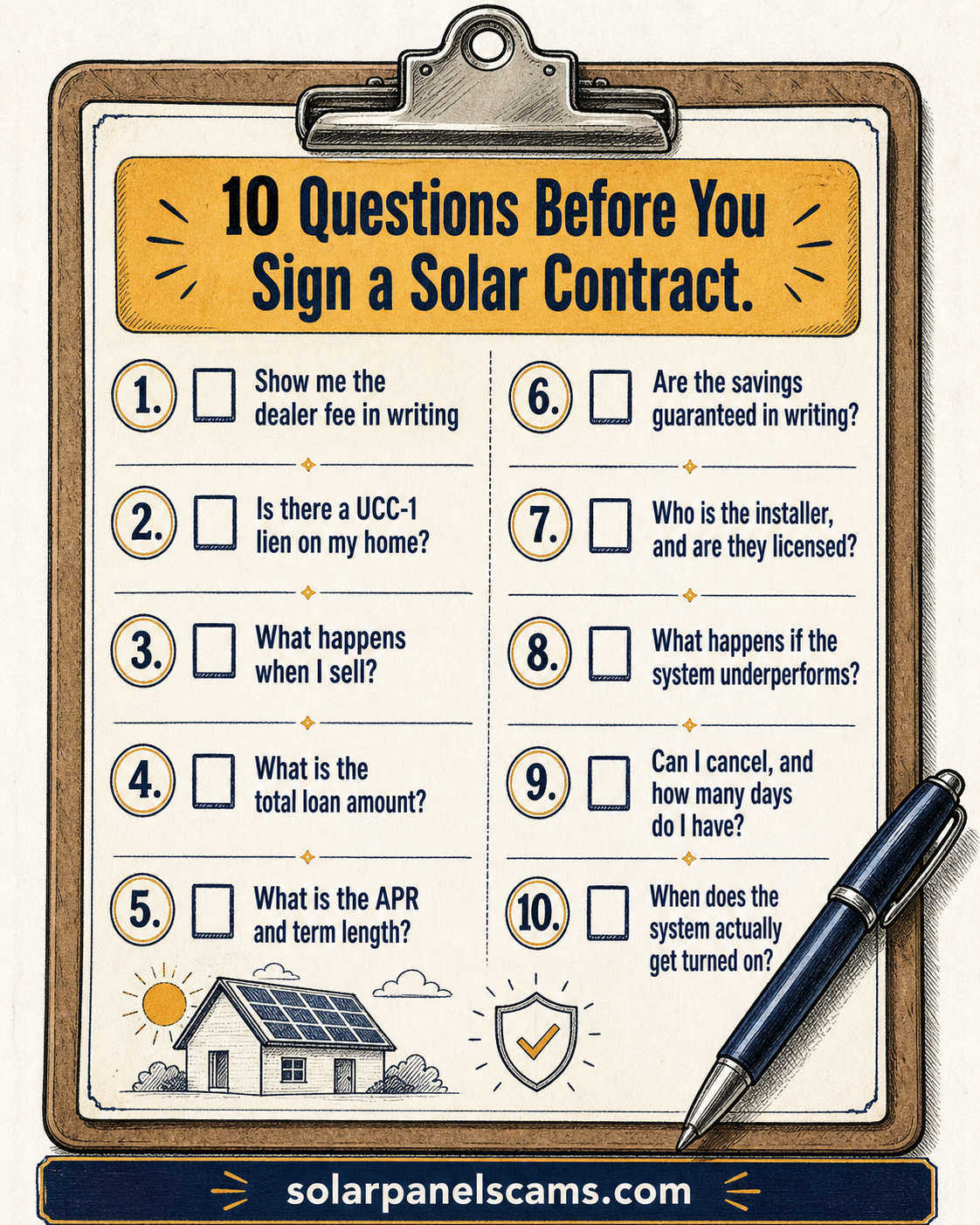
Treat the checklist above as a pre-signing script. Ask each question in writing, require the answer in the proposal or contract, and do not accept "we will explain later" as an answer. The most expensive solar problems usually appear in four places: the loan amount, the cancellation notice, the installer identity, and the title/lien language. One more thing happens before signing that homeowners often miss entirely: the credit application. Know whether a solar company can pull your credit without consent before you let anyone type your details into a tablet.
The 10 Questions
1. What is the dealer fee on this loan, stated as both a dollar amount and a percentage of the system cost?
Do not rely on a national percentage. Ask for the same seller's gross cash price and financed price, then reconcile batteries, roof work, electrical upgrades, taxes, rate-buydown costs, and other add-ons. A gap may contain financing costs, but the gap alone does not prove its composition or fraud. If you already signed, use the post-sign solar pricing worksheet.
2. Will a UCC-1 financing statement be filed, and what collateral does it describe?
Get the exact collateral description in writing. If it says "all improvements and fixtures" or "all personal property," you are potentially encumbering far more than the solar panels. Demand language that limits the collateral to the specific equipment only.
3. Is this PACE financing? If so, what is the total assessment amount, the interest rate, and the lien priority?
PACE financing is repaid through a property assessment rather than an ordinary installment loan. Priority, mortgage-consent, transfer, delinquency, and disclosure rules vary by program and jurisdiction. Ask explicitly whether the proposal is PACE, obtain the assessment documents, and have the lien and mortgage consequences reviewed before signing.
4. What is the total cost over the full term, including all escalators, fees, and taxes?
The monthly payment quoted today may not be what you pay in year 5 or year 15. If a lease or PPA includes an escalator, ask for every year's payment through the contract end. If a battery or backup package is folded into the total, confirm its separately itemized price and exactly which circuits it powers. For uncertain service or equipment charges, compare the scope with the solar repair-cost worksheet.
5. What are my cancellation rights, and what happens if I cancel?
The FTC Cooling-Off Rule gives a three-business-day cancellation right for covered sales made at a home or certain temporary locations, subject to scope and exceptions. State law or a specific credit transaction may provide different rights. Ask which rule applies, obtain every cancellation form, and follow the contract's notice method and deadline without assuming that one federal rule covers the transaction.
6. Is the payment schedule tied to milestones — specifically, when does the first payment become due?
Some payment schedules begin before installation is complete or the system passes inspection. Ask what event triggers installer funding and your first payment, who verifies it, and whether inspection or PTO matters under the actual documents. A milestone schedule can reduce ambiguity, but it does not override the loan or installation contract.
7. Who claims the federal tax credit, and what happens if I am not eligible?
Section 25D is unavailable for expenditures treated as made after December 31, 2025. A qualifying 2025 installation may still be claimed or carried forward subject to the taxpayer's facts and tax liability. Do not price a 2026 proposal around an expired residential credit. Review the current federal solar-credit timing guide with a qualified tax professional.
8. What warranties cover the system, who backs them, and for how long?
Distinguish between manufacturer warranties (panels, inverters), installer workmanship warranties, and production guarantees. Ask whether the warranty is backed by the installer, a third-party insurer, or the manufacturer — and whether the installer will still be in business when a claim is needed.
9. Who owns the equipment, and what happens to it at contract end?
In a PPA or equipment lease, a third party generally owns the system. End-of-term options and costs are contract-specific. Get the buyout formula, extension terms, removal responsibilities, timing, condition requirements, and any fees in writing before signing.
10. What happens if I sell my home?
Some solar obligations transfer, while others require payoff, buyout, assumption, lender consent, or other steps. Ask about buyer qualification, UCC release, mortgage-lender requirements, fees, deadlines, and what happens if a buyer declines the agreement. Do not rely on a promise that transfer is automatic.
Regulatory Backing
These questions map to real disclosure frameworks, but coverage and remedies depend on the transaction. California has solar-financing disclosure requirements for covered agreements. The FTC Cooling-Off Rule governs covered home-solicitation sales. Regulation Z defines federal credit disclosures such as APR, finance charge, amount financed, payment schedule, and total of payments. Written answers make the proposal easier to compare and preserve what was represented.
Official Sources Behind the Questions
- The CFPB's solar financing issue spotlight explains dealer fees, loan structures, and consumer risks in residential solar financing: CFPB solar financing issue spotlight.
- The FTC Cooling-Off Rule text explains cancellation requirements for covered home-solicitation sales: FTC Cooling-Off Rule text.
- The Department of Energy explains how leases, PPAs, loans, and cash purchases differ: DOE homeowner's guide to solar financing.
- The Department of Energy recommends verifying installer credentials, insurance, subcontractors, and certifications before hiring: DOE guide to choosing a solar installer.
- The Treasury advisory highlights solar complaints involving costs, savings, loans, tax credits, and aggressive sales tactics: Treasury consumer advisory on solar energy scams.
FAQ
Do I really need to ask all ten questions?
Yes, and get the answers in writing. The legal effect of a verbal statement varies, while a written proposal, contract term, or message is easier to preserve and compare. If the salesperson cannot or will not answer a material price or obligation question clearly, do not sign until it is resolved.
What should I do if the salesperson refuses to disclose the dealer fee?
Do not sign until the seller provides enough written information to reconcile the cash price, financed price, amount financed, finance charge, total of payments, and add-ons. Whether a separate dealer-fee disclosure is legally required depends on the transaction and state; a qualified adviser or regulator can assess a suspected omission.
Can I ask these questions after signing?
You can, but a cancellation deadline may already be running. The FTC rule provides three business days only for covered sales, and other rights may be shorter, longer, or unavailable. Follow the contract's notice instructions promptly and get state-specific advice rather than assuming the federal rule applies.
What regulatory bodies enforce these disclosures?
The CFPB enforces TILA. The FTC enforces the Cooling-Off Rule. State attorneys general enforce consumer protection statutes and — in some states — specific solar disclosure laws like California SB 784.
Got blindsided by a solar deal that did not deliver?
Your documents may support a contract, disclosure, financing, or consumer-protection issue. Available claims, remedies, deadlines, and fee rules depend on the transaction and state. Our eligibility form organizes the facts for review and may route qualifying matters toward a consumer-protection attorney.
Next Research Steps
Use these resources to connect this issue with the broader solar scam pattern, the relevant legal framework, and the next practical action.
Solar panel scams
Start with the main solar panel scams guide for the broad definition and recovery roadmap.
Solar financing fraud compensation
Use this guide for loan, dealer-fee, payment-jump, PACE, lease, and lender-defense issues.
Homeowner legal rights
Review cancellation, rescission, UDAP, TILA, Holder Rule, arbitration, and lawsuit options.